
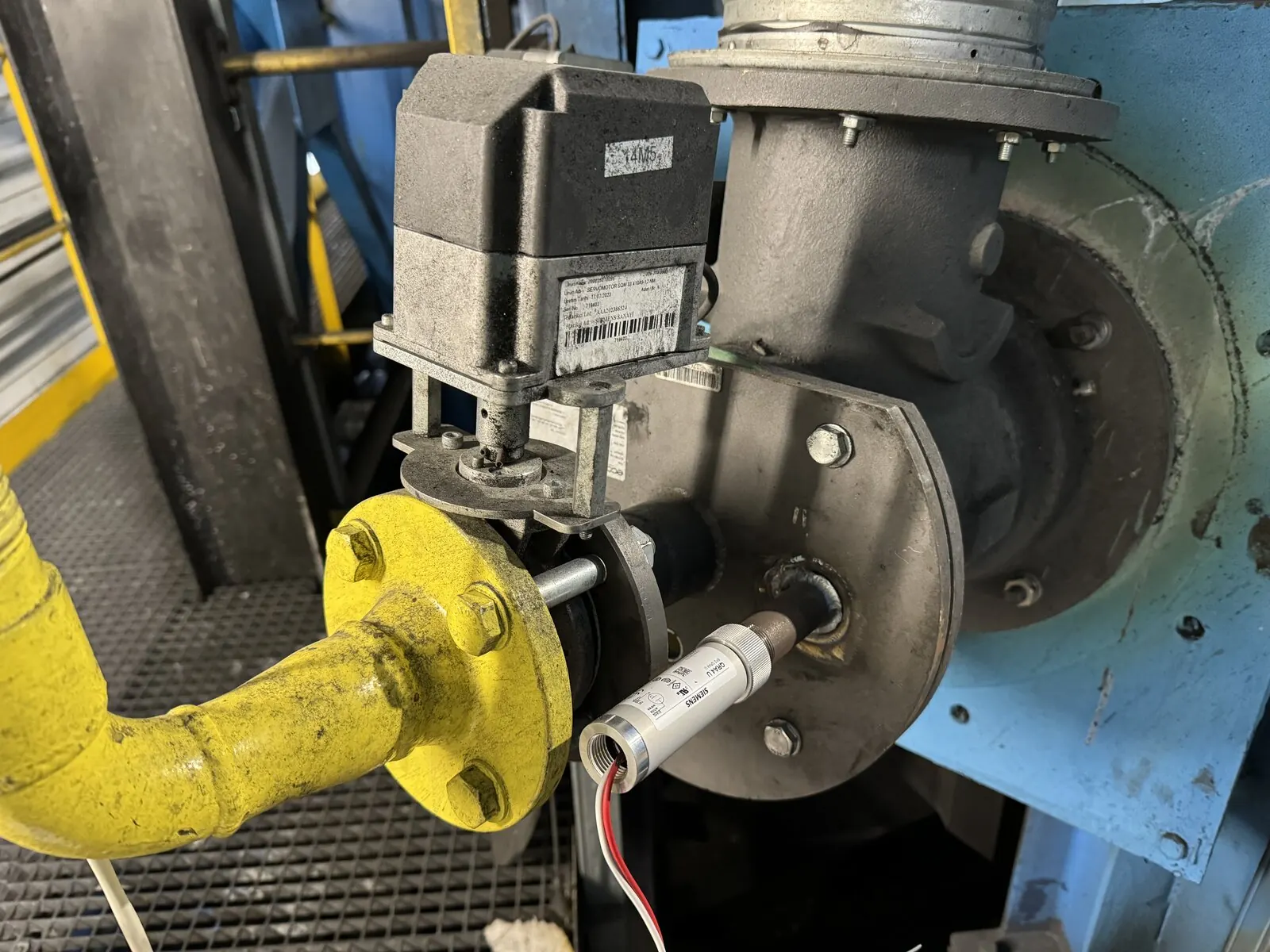
Burner selection — where to start.
Three pieces of information are enough to identify the right burner family: thermal power, fuel and combustion chamber pressure. Below is a checklist and a fuel-consumption calculator.
A correctly sized burner runs in the middle of its power range, meets the boiler's requirements and causes no start-up problems. A poorly sized one runs at the edge of its range, cycles on and off frequently, or fails to reach the required parameters.
Checklist
- Thermal power. The burner's power is the boiler's power divided by its efficiency (the burner supplies more heat than the boiler releases). Look for it on the boiler's or furnace's nameplate.
- Fuel. Natural gas, LPG, light or heavy oil — or two fuels. This determines the burner family.
- Combustion chamber pressure. The burner has to overcome it. The boiler manufacturer states it; for furnaces and dryers it has to be measured or estimated.
- Control type. One power stage, two stages, or modulation. Modulation improves stability and efficiency under variable load.
- Installation constraints. The length and diameter of the burner head, the boiler flange, the available space, and room ventilation.
- Accessories. A gas train or oil supply, a control panel, and possibly combustion controls with O2 measurement.
Fuel-consumption calculator
The formula from the manufacturer's manual: consumption [Nm³/h] = power [kW] × 860 ÷ Hu [kcal/Nm³]. For a power of 500 kW and natural gas with Hu = 8,250 kcal/Nm³, the result is 52.1 Nm³/h. You can enter your own values below.
Examples from the manufacturer's tables
To see how the power ranges correspond to specific models, check the tables: ECO gas burners, oil burners, FPB process burners.
Send us your data
A phone call or the form will do. You can e-mail a photo of the boiler's nameplate to biuro@royal-system.pl.
Send us the data from the boiler or furnace nameplate — we will size the burner.
Power, fuel, combustion chamber pressure. We reply within 48 hours, with no obligation.